


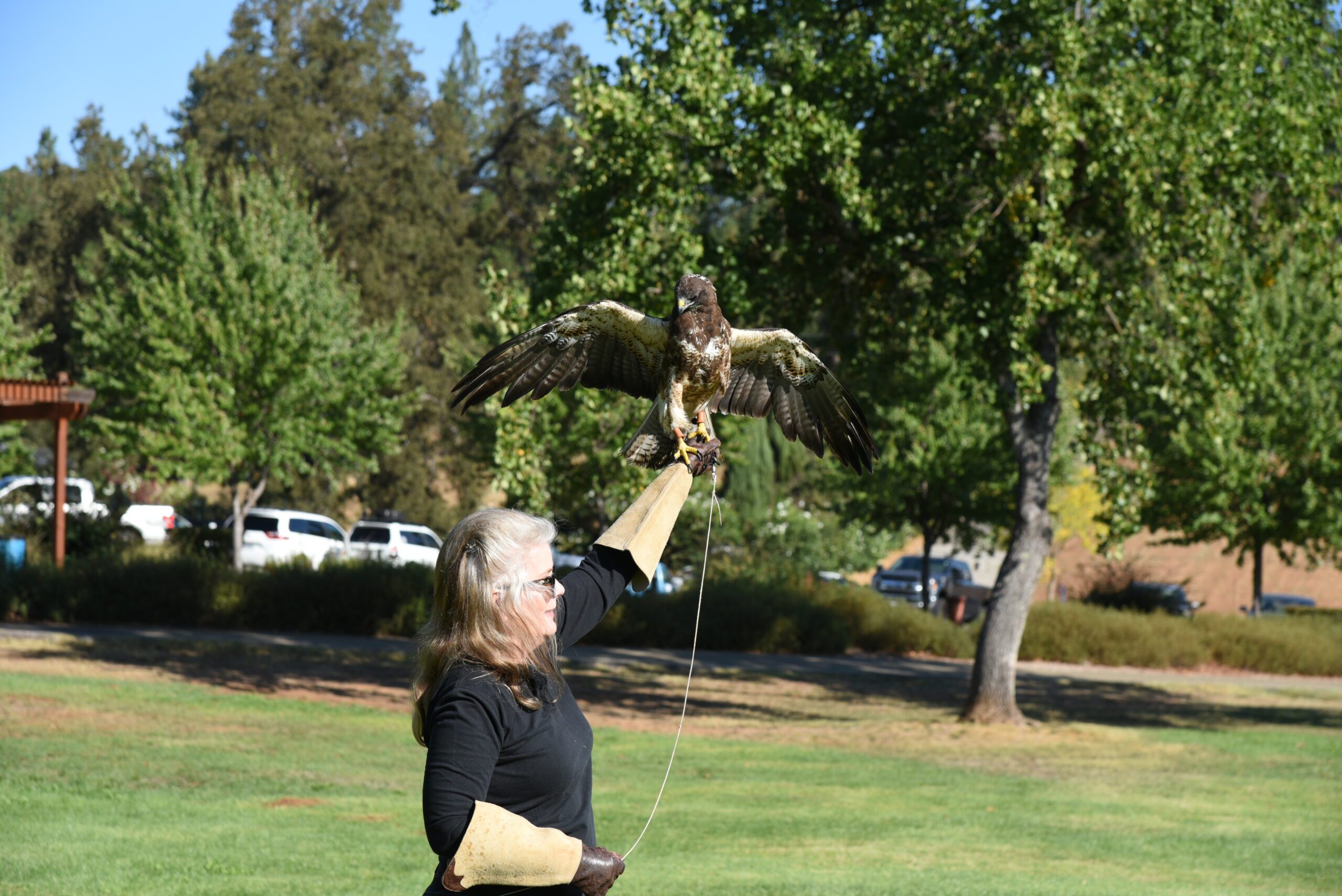

Auburn, Calif. – On an early fall morning at Meadow Vista Park, while families gathered for soccer and people walked their dogs, an unusual visitor prepared to take flight over a grassy area by a pond. Under the watchful care of Kari Freidig, a Master Falconer and 20-year veteran raptor rehabilitator, a Swainson’s hawk took her first flight toward freedom after more than three months of rehabilitation.
The Swainson’s hawk, a California-listed threatened species, arrived at Gold Country Wildlife Rescue after local residents found it injured by a possible collision with a car near the city of Lincoln, Calif.
Freidig, one of Gold Country’s highly trained rehabilitators, took possession of the hawk to guide it on its healing journey with the hope of release.
“When she first arrived, she had X-rays and a full examination by a veterinarian,” said Freidig who described the hawk as an older female. “Luckily, she didn’t have any broken bones, but there was soft tissue damage which made it hard for her to fly.”
With flight being critical for foraging and avoiding predators, Freidig began the hawk’s rehabilitation process, moving through stages of healing, rebuilding strength and retraining for flight in flight cages.
Rehabilitating raptors (which includes eagles, falcons, hawks, kites, osprey, owls, and vultures) takes specialized training – not just in how to feed the raptors – but how to work with them, and when appropriate, how to reteach them to fly and hunt. Freidig’s training as a Master Falconer forms the foundation of her success in working with these birds.
Falconry’s exact origins remain unknown, but multiple sources agree that the sport is at least 4,000 years old and likely originated in the Middle East or Central Asia. Humans used raptors for hunting small game like rabbits. Overtime, falconry spread through trade and cultural links to North Africa, Europe and beyond. In 2021, the United Nations Educational, Scientific, and Cultural Organization placed falconry on the List of the Intangible Cultural Heritage of Humanity.
To be falconer in California today requires securing a license through the California Department of Fish and Wildlife. Falconers must be knowledgeable about the natural history of raptors, the practice of falconry and identification of raptor species, habitats, and behavior. Falconers must serve as an apprentice falconer for a minimum of two years. To apprentice, a falconry student must find a master falconer to train and practice with, to learn about and obtain the right equipment, to design housing and to learn techniques for capture, care and training. For Freidig, the falconry skills naturally supported her raptor rehabilitation work.
“The hawk has been flying the length of the flight cage successfully which is about 30 yards,” said Freidig. “But in order to release her back to the wild, she needs to show that she can fly much farther successfully.”
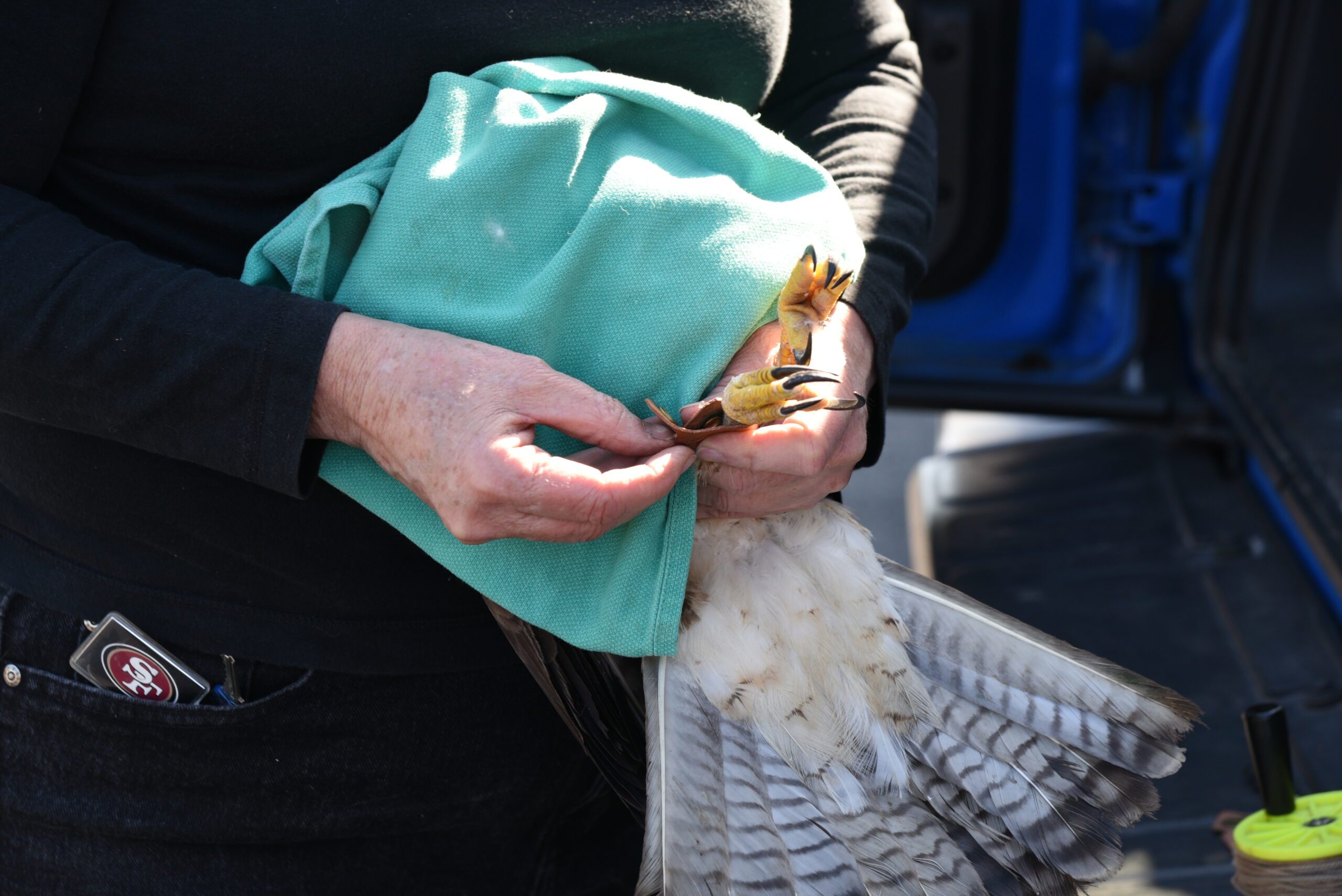
At Meadow Vista Park, Freidig used a light creance line which is a tool falconers use to train a hawk for free flight hunting. Freidig adapted this tool to use it for reconditioning injured raptors.
She “tethered” the hawk with the creance line which allowed her to create “drag” to keep the hawk low and within a certain distance. The creance line allowed Freidig to safely test the Swainson hawk’s flying ability, watching for wing droop and other signs that would indicate whether the hawk was ready for release. Freidig needed to be able to recover the hawk if the bird showed signs that it was not ready for release and still needed care. After a few test flights, Freidig completed the assessment and recovered the hawk.
“She is a lucky bird! She showed the strength and ability needed to be released,” said Freidig who hopes to release the hawk soon in the Lincoln area where the bird originated. “The Swainson’s hawks will begin migrating to South America in the coming months, so we may get her released in time to join the others as they migrate.”
The California Fish and Game Commission listed the Swainson’s hawk (Buteo Swainsoni) as a threatened species in 1983, based on habitat loss and decreased numbers across the state. In 2005, a state-wide survey was conducted in the known range and showed a state-wide estimate for the number of breeding pairs at 2,081. Surveys conducted in Butte to San Joaquin counties during the period 2002-2009 showed numbers of breeding pairs of Swainson’s hawks at 593 in 2002; 1008 in 2003; and 941 in 2009.
The Swainson’s Hawk breeds in the western United States and Canada and winters in South America as far south as Argentina. Adapted to the open grasslands and often nesting near riparian systems, the Swainson’s hawk has become increasingly dependent on agriculture, especially alfalfa crops, as wildland converts to agriculture or succumbs to human development. The diet of the Swainson’s hawk in California mainly consists of small rodents called voles; however, other small mammals, birds, and insects are also taken. Once they fly to South America, their diet focuses more upon large insects. Western Placer County has great Swainson’s hawk habitat, and Freidig looks forward to returning this one back to the wild.
In late September, Freidig released the rehabilitated Swainson’s hawk back to its territory which is near the area where the hawk originally was found.
Kari Freidig, in addition to being a Master Falconer and wildlife rehabilitator for more than 20 years, served on the Placer County Fish and Game Commission in California from 2008 to 2020, with several terms as chair.
###
