

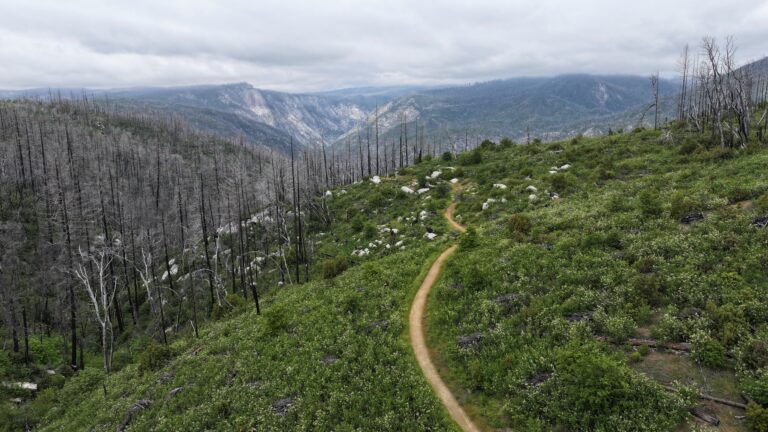
Butte County Collaborative Group (BCCG), Plumas National Forest, and Mooretown Rancheria organized a tour, along with Sierra Nevada Conservancy (SNC) staff, to see the Feather Falls Trail Area on May 6, 2026. This is a really special area considered to be the heart of Mooretown’s ancestral lands. After the 2020 North Complex Fire, there was nearly 100% tree mortality and organizers of the tours described this area post fire as almost a moonscape.
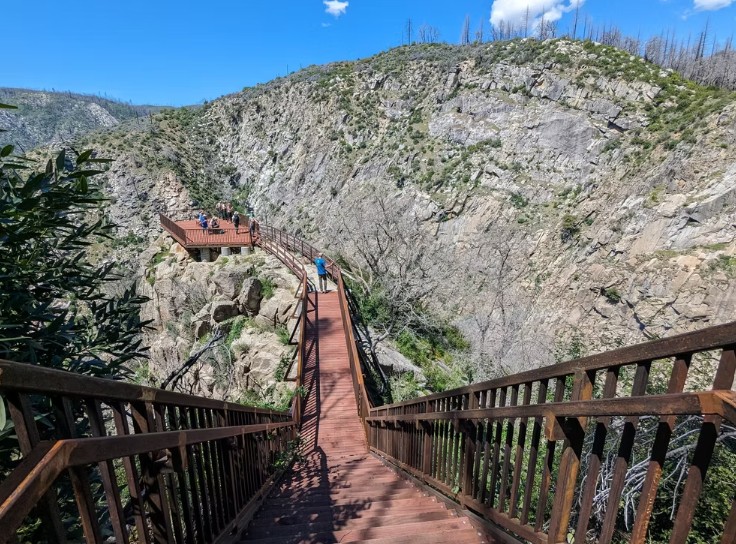
The work here since has helped the land begin to recover. The trail bridges, the scenic overlook and campground were destroyed in the fired. The trail bridges and scenic overlook have since been rebuilt and the trail reopened in autumn of 2025. This area used to be lush with trees along the trail. Through the efforts of these collaborations it looks like that will, again, someday be true.
Mooretown’s first application to SNC was for a grant to help pay for the post fire cultural surveys as well as monitoring while the US Forest Service (USFS) was doing hazard tree removal. Mooretown is currently focusing on areas of a campground and its reconstruction as well. The Feather Falls Trail is a great location for recreation and the hike takes you to a 410-foot waterfall and a scenic overlook nearby. Be careful in warmer seasons as it can get quite warm without the protective tree canopy in this post fire landscape.
Through scores of generations, the Concow Maidu Tribe lived with and cared for a vibrant forested landscape at the northern end of the Sacramento Valley where the foothills rise to the crest of the Sierra Nevada. This landscape, spread between the Middle and South Forks of the Feather River, was and still is home to a diverse array of fire-adapted wildlife and plants—including owls, eagles, woodpeckers, butterflies, and bees.
In 2020, the North Complex Fire raged across this landscape. The high-severity burn killed nearly 100% of the vegetation and devastated the community of Feather Falls. Although this high-severity burn ravaged the mismanaged lands, it also created an opportunity for the Tribe to purchase a portion of its homeland, approximately 3,000 acres in the Feather Falls area. Further expanding this return of Indigenous hands to Indigenous lands, the Tribe entered into a nationally recognized Co-Stewardship Agreement with the Bureau of Land Management (BLM) on approximately 1,000 acres adjacent to the newly acquired Fee Lands. This new access to previously neglected land is further bolstered by a Master Stewardship Agreement the Tribe has entered into with their most active and supportive federal partner, the Plumas National Forest. The Tribe has been conducting hazard tree removal in the USFS Feather Falls area for several years, has helped reestablish the much-loved Feather Falls Trail (a nine-mile loop to a 410-ft. waterfall), and has conducted many of the surveys in the burned landscape to identify and protect cultural resources that had not been visited for generations.
The overarching goal is to reinstitute integrative, long-term post-fire management that supports wildlife and habitats across 4,000 acres that we call the Feather Falls Tribal Cultural Landscape. This project focuses on Post fire Restoration Planning, Tribal Wildlife Monitoring, and Capacity-Building and will advance habitat connectivity and support pollinator species and plants that are important for Traditional Ecological Knowledge (TEK). Once funded, this project will allow the Tribe to grow its burgeoning GIS department and support a full-time TEK specialist to work with the GIS technician to merge these different ways of knowing the land. These two positions will establish the monitoring plots and install the instrumentation using Tribal Interns as an extension of the Growing Natural Resource Professionals program.
The result of planning and monitoring will be a restoration portfolio that can be implemented as additional grants are secured to maximize habitat health, resilience, and connectivity across land ownership. The overall monitoring, planning and restoration effort will build toward a resilient future that honors relations with plant and animal species.
